Showing posts with label art. Show all posts

Wednesday, March 25, 2015

Seduction of the Innocent by Skinner


Over the last two months I have been working on paintings for my show at Vinyl On Vinyl in Manila, Philippines. 10 paintings that were to combine my love of silver age comics, the aesthetic style of it influenced from different kinds of comics at the time of the silver age. A little before or after as well, KIRBY/DITKO bombast and action, E.C. Comics creepiness and sci fi weirdness as well as pre silver age stuff of the likes of L.B Cole.

I set out to do some weird comic book panel art that would be fun and easy to do for the show in Manila. It was fun and indulgent even, but something happened as I was painting these.. I was listening to Jack KIRBY interviews on YouTube and after I listened to all of those I was referred to Alan Moore interviews and grant Morrison interviews. The Jack KIRBY interviews fascinated me because I love Jack Kirby and what he has done is sort of mentor me from beyond the grave by providing the most incredible example of blue collar work ethic not to mention how weird and impressive and beautiful his imaginings always are. He’s not called the king for nothing.

Well the Alan Moore and Grant Morrison interviews really set my mind off into a kind of interest in the psycho mental and spiritual involvement that creativity can invoke. A sort of journey beyond the normal dimensions of story concepts and art as an imaginative astronaut willing to take on a mental freedom no matter how bizarre it could be. A few Alan Moore interviews really got me thinking about how important socially active and antagonistic art is. That it is at its best when it is for the people, not the status quo standard of self-congratulating upper art echelons not available to the average joe. It renewed my sense of this, although my modus operandi is to put my art in the hands of anyone if I can.

I then was in a mutational stage of silver age comic book social antagonism, which is ridiculous enough but then I started on the Robert Anton Wilson and Terrence Mckenna interviews. Which completed my journey by bolstering my love of the absurd and the freedom it brings by overthrowing any current form of social niceties and standards as well as kind of opening my mind to the spiritual shift that human beings are capable of spiritual awakening through drugs and consciousness. So of course whatever paintings I was working on by the time I was listening to Terrence McKenna, were completely taking an aggravated stance towards mentally inhibiting institutions, the church, military industrial complexes, etc.

Of course I had to buy a couple of ounces of mushrooms so I could take them when I get back from my trip over seas. Summer is good for hiking and spirit morphing! Haha!! So as I was painting this batch of weird paintings, I realized that a lot of what I was commenting on in these paintings were very Americanized themes and concepts, some emotional and some political. I then thought of how the show was in the Philippines, which is a country that I hear loves aspects of our western culture. I thought of Fredric Wertham who wrote a book called " Seduction of the innocent" in 1954, which all but destroyed the comic book industry in the late 50's. It put EC comics out of business, and the book claimed that comic books were influencing children with horrific themes and violence to be terrible, twisted future criminals. It struck me that what really turns us into twisted versions of what could actually be, a peaceful beautiful organic occurrence on earth, are our warlike behaviors, our social conditioning and standards, our subjugation and mental enslavement via stupid religions of ourselves and others. (There’s a lot more to touch on but let's stick with only a few for now) Comic books don't make for a shitty world. People doing the same dumb shit for generations and continuing the stupidity and lazy minded selfishness because we are addicted to things that work for us as an individual but put others back. We can't evolve if only a couple of people can afford it.

So I named the show "Seduction of The Innocent", an art show of my wacky and critical commentary on some of our collective struggles as well as social/political institutions that I think will never get enough spankings, and laying it out in my favorite art form style, comic books. It has been an incredibly fun exercise into trying new things and pushing myself to do things I never had the discipline to mess with. (I’m looking at you, insane old timey comic fonts) the show starts on March 25th. A few days after my opening in Japan at Mishka Tokyo, which is where we are showing my new window display/installation for them on March 20th. If anybody can come out and see me I’d love to see your face!

Thank you for reading my long pontificating description on how I arrived in a place of total confusion. -Skinner


Wednesday, March 4, 2015

Tropes of Expectations by Manuel Ocampo, Javier Arce, Juan Carlos Quintana, Carlo Ricafort, Timo Roter


When Private Ricafort, Private Quintana, Private Arce, Private Ocampo and Private Roter met the first time in 1965 it was the hottest December day in the history of Vietnam. Not knowing that there was no right and wrong they were still fighting with General Nguyen, whose nickname for them was Sgt. Sio-Mai, against the intruders.

The 5 were the only guys digging tunnels that time in CĂș Chi, listening to b-52's (the band!) when they accidently hit a wormhole with their shovel which threw them into an alternate universe.
General Nguyen was a wealthy man so he cloned the 5 and sent them back home to their places.
Through the telepathic knowledge the 5 got when they entered the alternate universe they are now able to operate and direct their clones and let them paint what they see in their Galaxy.
After 50 years the original 5 met the first time, they are sending now their clones to Manila to have their first groupshow at Vinyl on Vinyl.


Sunday, February 15, 2015

False Assault by Patch Quinto


Usually after spending academic years, whether you've failed it or not, questions raised about life and how to live it, transforming learning to mainly just earning, bringing yourselves toward the promise of what has been subliminally dictated to you as "the good life".

You wake up, you check your clock. As a weird sedating consciousness latches onto your head, with its central incisors making its way to your cranium as it tears your thin scalp. Your jaws lock, eyes  twitch as a rapid sequence of images is about to enter your automated condition in the mundane fills your brain. Struggling with routines, tangled between the weaves of work assigned to you as a peons in the service to whatever company you are tied to, striving for each quota-per day required, flowing in a unison as a member of the labor force. You drown in your right thoughts and clouded judgement as you try to live up to this striking consciousness that crossed your mind and you find it impossible to mobilize because of the uncertainty of where this consciousness would lead you.

It's Patcho's second solo exhibition, the expansion of consciousness appears to be malignant in offering us severed details in relation to what he encounters as an active participants of the labor force. Unsettled though limitations and confinements defined his job as a graphic designer for websites a continuous progression on his art practice results to a non-secular type of production that includes basic elements composed of repetitive lines, shapes and outburst of colors illuminates multi-layers of amalgamated images creating a monotony of satirically animate/inanimate subjects. The inclusion of popular visual tropes draws his viewer towards analyzing Patch's critique about the effect of popular media in a larger spectrum. Anatomically grotesque representation of dissected human flesh raises discussions and coherent inquiries of the basis of questioning human perception and behavior. Moreover, his familiarity of using lines as a continuous transgression from each subject to another consistently projects the whole series of works.

Importantly, lest we forget the artist exhibition of his recent works must be examined in acquiring his own solutions on his capabilities in transforming significant observations and progresses based on his daily routines rooted in his art-making. It's not product itself produced as a graphic designer or as an artist but how he manages and still enjoy to co-exist between to similar dichotomies.

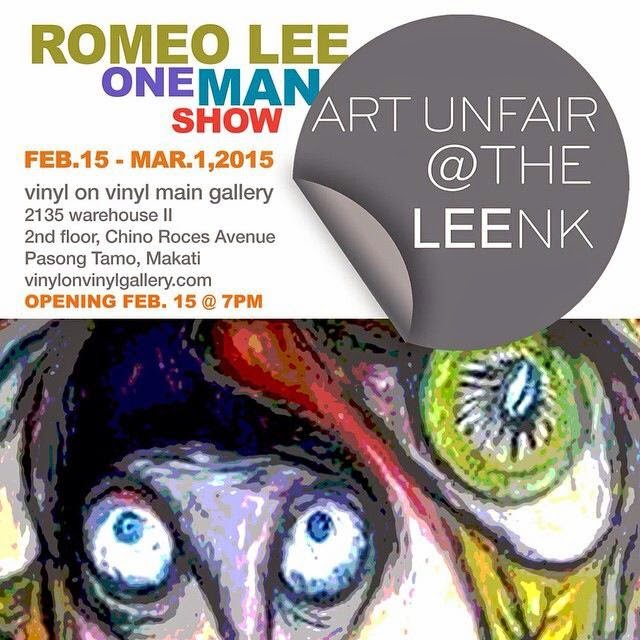
Art Unfair At The Leenk by Romeo Lee


Wednesday, January 28, 2015

Pieta by Tokwa Penaflorida and Mayi


The bond between mother and child is bound by the instinct of nurturing. It is the core of all things living, from the conception of galaxies to the most minute organisms. It is eternal, bypassing death, like a piece of art that continues to inspire people through time.  
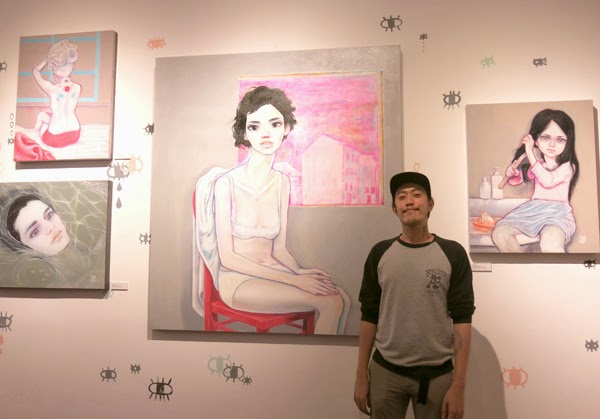
Michaelangelo’s, La PietĂ , inspired mother-and-son artists Mayi and Tokwa Peñaflorida to illustrate the bond between mother and child and to juxtapose it to the concept of creating art in their two-man show, PietĂ . Mayi, whose influences include John William Waterhouse and William-Adolphe Bouguereau, twists the classical style with contemporary form, morphing the human anatomy: enlarged heads frame oversized and glimmering eyes, svelte necks and limbs, clothed in an intricately detailed drapery. With the works of Gustav Klimt and Alphonse Mucha as his inspiration, Tokwa maintains the dark, dreamy, and romantic qualities of his paintings in which he is known for.
The two artists’ style, although starkly different from each other, converge as they explore the softness and caring nature of motherhood. Their main piece, Pieta, is a reinterpretation of Michaelangelo’s famous sculpture and is the cord that holds their show afloat. Mayi painted Christ, while Tokwa painted Mary—the son painting the image of the mother, and the mother painting the image of the son. This creation process is a symbolic illustration of their concept, the mother who conceived and gave birth to her child, is a part of her, and it is her that truly sees—feels—the suffering of her child. Same as with the son, who was nurtured and cared for by his mother, and has an astronomical emotional connection with her. 
The creation process of any artist—writers, sculptors, painters—is similar to a mother who carries a child in her womb. The artist’s womb is his brain, where the concept is the unborn child, nurturing it with his observation of the world, his visions, and inspirations. He feels the strongest attachment to it, as it is his, made by his own synapses and neurons and emotions. As he executes his art, on paper or marble or canvas, he delivers his child into the world. And at that point, his child is no longer entirely his—it is now for the world to see, and for the world to nurture. He becomes physically parted from his child, forever.
However, this feeling of loss, solidifies the unseen, maternal bond. PietĂ  by Mayi and Tokwa Penaflorida is not a representation of this—it an incomplete experience, where the audience is given space to conceive.


Stripe by Arkiv Vilmansa


16:26 by Renz Bautista


“For what is a man profited, if he shall gain the whole world and lose his own soul? Or what shall a man give in exchange for his soul?”
Matthew 16:26 21st Century King James Version (KJ21)

I wonder if God can grant us to bet our soul in exchange of something we really want. I wonder if someone can make our dreams come true in exchange of our own soul. I wonder if we can exchange it for immortality or god-like power. I wonder if I can sell my soul in exchange of peace. I wonder if I can give my soul in exchange of freedom. I wonder if I can just give my soul in exchange of nothing. I wonder if I can trade my soul in exchange of eternal sleep. I wonder if I can trade my soul to limitless happiness. I wonder if I can wish infinite time in exchange of my soul. I wonder if I can trade someone’s soul in exchange of my wish.

I wish I could trade something else rather than my own soul. I hope I have a soul to trade in exchange of my wish. 

Based on the Bible verse from the book of Matthew, the concept behind Renz Bautista’s first solo show was described by the artist as serendipitous and inspired a deep insight into his personal psyche.

His paintings were borne out of introspection which come to grips with some of life’s most profound questions. His process encouraged a personal dialogue on the trade-offs that we make in our day-to-day lives.
Through his use of layers and layers of paint and paper, he realizes the complexities of these exchanges and hopes to discover clarity amidst the disarray that casts a looming shadow over him.

Born in Cavite yet a pure Bulakenyo, Renz Marrione Bautista is a personification of youth with a heart for art. Bautista is a Fine Arts major in Advertising student of Bulacan State University who has exemplified his skills in different fields. He has topped visual arts competitions like the 4th Cocolife Colors of Life Student Visual Arts Competition – Runner up (College category), 2011 National Student Art Competition (Art Petron) – Grand Prize (T-shirt design) and Semifinalist (Painting category), 43rd Shell National Students Art Competition (NSAC) – 5th honorable mention, 2010 & 2014 Metrobank Art Design Excellence (MADE) – Semifinalist, and, a grandprize winner in the 1st Bulacan State University Painting Contest.

Aside from his artistic excellence, Bautista has contributed in BulSU’s official student publicaton, Pacesetter, as a member for 3 years and the Art Director for his last year. He has won Regional and Luzonwide press competitions in editorial cartooning and comic strip drawing.


Thursday, December 11, 2014

Melting Point! by Rai Cruz, Quatro, Tyang Karyel


Dec. 11, 2014
Vinyl on Vinyl Gallery: Left Wing

MeltLab is a group of three street artists who have come together based on
the common idea of melting individual boundaries and working together as a
unified entity. Their challenge is one that allows them as well to move beyond
the streets that they have individually navigated, to spaces that will engage
with their artistic task of making art that is functional, and is not merely
hung on gallery walls or homes. 

Rai Cruz, QUATRO (Quatro Los Banos), and TYANG (Carriel Santos) are
MeltLab and they work in various forms of art such as: painting, customizing
objects, assemblage, murals, and public art. Their specifice experiences in
public spaces that has allowed MeltLab to believe in the ability of the visual
arts to genuinely connect with people, and their goal as well is to establish a
business that is a reflection of this belief.

Any space – from city streets to home interiors, blank rooms to bars –
can be activated by an art piece, one that initiatesand encouragesreflection
and critical thinking. The practice of public art reminds us that while
television and technology have captured people’s attention, spectators engage
with the visual arts differently, where Interaction is one that’s about sitting
and staying, and having conversations. 

MeltLab levels up the spectator’s conversation with art by
re-envisioning these as functional and familiar objects such as common
household furniture. It is this combination of normal and standard shapes and
furniture vis a vis the extraordinariness of the visual art that will adorn it,
that is at the heart of this project. This exhibition is an antidote to the
prevalence of mass produced items, where we trust that an art audience would
know to appreciate the value – aesthetic, reflective, thought process behind –
one-of-a-kind hand-crafted pieces of functional visual art. 

MeltLab has long wanted to work beyond the spaces of the streets and
beyond our usual canvasses of wood / cement / paint. Without a doubt, working
on simple functional pieces and reworking these into art pieces can only be a
level-up to the work we usually do. -Katrina Stuart Santiago

Gaze by Miguel Paulo Borja


Miguel Paulo Borja
Dec. 11, 2014
Vinyl on Vinyl Gallery

"The gaze sees itself, the gaze surprises me; reduces me to shame. This gaze is not a seen gaze but agaze imagined by me in the field of the Other." ~ Jacques Lacan

When an artist creates art, he brings to life an inanimate object by giving it purpose and projecting himself into his art; and when a viewer gazes into a work of art, who is to say that the artwork does not gazeback, suddenly aware of its purpose, fleeting as it may be.

The term gaze is defined as looking steadily and intently at someone or something. This steady look, however, may be a look of admiration, surprise, scrutiny or even a simple thought. A gaze received by the viewer can be interpreted in different ways. The viewer struggles to understand the intent of the persongazing at him and ultimately projecting his own thoughts and ideas onto that person. The gaze acts as mirror that reflects what we want to see and how we want to be seen.

As we search for our purpose and meaning in life, we reflect on ourselves by looking at our life in the eyes of another. Objectively and subjectively unwrapping the layers of our past and present, hoping to find something that will define our existence and open our eyes to realities as well as possibilities.

In "Gaze", Miguel Paulo Borja imagines a literal depiction of this symbiosis between art and viewer, and ultimately between art and artist as he paints portraits that seem to gaze into the abyss and back at him, sharing questions of their existence and hoping that somewhere out there is a viewer in the abyss thatgazes back.

Child's Hood by Gabby Tiongson


Dec. 11, 2014
Vinyl On Vinyl Main Gallery

We each go through distinct experiences during our childhood. Experiences that mold and impress upon us memories that we unconsciously collect. No matter what walk of life, we all relate to similar emotional experiences during our early years. As children, our innocence allows us to encounter these emotions in its purest form. For example, the bliss felt when we watch our favorite cartoon show. At that moment, nothing else matters in the world. This feeling continues until one grows up and then reality sets in. As adults, we live in the real world while clinging on to that profound happines.

Adulthood bears many burdens of the real world. We worry about ourselves, our families, and our security to name a few. Anxiously agonizing over our responsibilities has become the norm. We contemplate on what our futures hold. More often than not, the emotional rollercoaster of life torments adulthood.

Tiongson says "I can no longer laugh the same way I used to as a child". His art reminds him of days when ignorance was bliss. He strives to capture and share those moments in his childhood where he genuinely belly laughed his face off without a care in the world.

He digs into his childhood memories and reflects it in his art today. For him it is the bliss of play which he holds on to that fuels his creativity. He grew up exposed to 90's toys, cartoons, comics, computer games, movies, and Japanese pop culture.

Tiongson thinks of himself as child-like in a sense that he yearns to feel the bliss of childhood. To cope with chasing that fleeting feeling, he surrounds himself with his aesthetics growing up. The immersion into cartoons, toys, music and play are what fills his void. This in turnis used as energy for creative output. His art practice is a journey of nostalgia. Tiongson creates characters that are reminiscent of his childhood but done in a corrupted manner. Whether he consciously or unconsciously does it, it is his way of finding Never land. He is searching for his child's hood that was all about enjoying the moment, an escape to a world wherein there are no bills to pay, no government to worry about, nor a supervirus to beat. He believes that it is his life's purpose to rediscover the bliss, that loss of innocence, and share it with his audience.

Friday, November 14, 2014

As We Lay To Bed by Dennis Bato


Nov . 14, 2014
Vinyl on Vinyl Gallery 

“Long story short . . . They forgot that they are all brothers and sisters cohabiting the same planet. So they kinda became delusional and imagined these invisible borders, Beliefs and structures separating them and started destroying each other and the Earth they live on . . . Instead of just living, sharing and evolving together. “

–Mike Adams & Dan Berger

Wake, eat, work sleep... and back to start, the cycle goes on and on just like a series of programs injected in our minds, morphing humans into mindless robots and foot soldiers.

Tradition, culture and beliefs greatly affect our society’s individual mindsets. In the verge of our modern stereotype era, everyone is shut in a delusion of living but in reality, turmoil and dismay lingers in each and every one of us. A temporary haven disguised in false hopes, greed, hunger, craving for something people want instead of need. Standards and practices create boundaries which entangle us in an imaginary prison cell that confines the freedom our thoughts seek, making every one a clichĂ© in a mirage; the future we are reaching for.

The society is racing towards the path of technological advancements and breakthrough, which we can say that the human instinct for survival has set an enormous impact on the system imposed in our society. People have the capability of struggling to survive but lack the strength to live. The question is are we still moving forward?

“As we lay to bed” tends to revoke the ideology of modern mindsets which were trapped within the norms of the past, redirecting our urge to get out of the edificial casing, the standards and practices that is enveloping our society, and society’s main element – you.

Lapses by Jood Clarino

Nov. 14, 2014
Vinyl on Vinyl Gallery

I read a book lately. It’s about two young men, travelling the globe for a week – with minimal necessities – giving away thousands of dollars along the way. They have to get rid of it as soon as possible, and as much as they can. Of course I won’t tell you that the succeeded in the most hilarious, creative, and daring way they possibly can. I’d ruin the very reason you bought the book.

But that’s not the point. I’m thinking, why do we need all that money anyway? Is it for power, greed, for our needs? We don’t need much, so why want more? We all know – or heard from someone, maybe God – that from where we came from, we shall return. And from where we came from, it’s a very small, dark place to fit everything we had in life. I admire these young men, whatever cause they believe in to give that much bills. They not only liberate themselves, but they found a way to tell the world, hey, you listen to me, and you better listen well.

The art exhibited has taken new grounds to liberate life from the velocity of these desires. With the use of nothing but pitch blackness, spray paint, and quick dry paints; the art captures the image of life stenciled in honest simplicity. It features the process of complicating one’s creativity – which everyone starts from – but executes in a very simple way. The artist relentlessly practices to eliminate his wants, the greed that accompanies these wants, and the selfishness that resulted from that greed.
Jood Clarino shows us that true beauty is not having a beautiful life, but having a simple life that radiates genuine beauty is a beautiful life. Some of us – most of us, if we admit it to ourselves – tend to do the same mistake of making things much more complicated as they already were. With probity, the exhibit frees us from the clichĂ©s we’re so used to breathing in; paralyzing us, making us slaves of ignorance. But maybe we still don’t get it, maybe because we haven’t looked closely, or maybe we still want more. Look into his art; know the beauty of true colors in pitch darkness. Then maybe we’ll see that it’s very simple. And it’s beautiful that way. Celebrate with us tonight, with art, with food, drinks, and with the company – that in truth – is all we need. - Teng Sibug

Saturday, October 25, 2014

See You Later by Thursday Room


October 1, 2014
Vinyl on Vinyl Gallery

“The idea of waiting for something makes it more exciting.”
-Andy Warhol

Having the ability to foresee the future, in all its ubiquitous glory is, of course, ambitious but possible. If only we knew what would happen, we can clearly avoid repeating mistakes and we can easily make elaborate plans that will take us one step closer to success and happiness. Life can only give us hints and we can only have gut feelings. But sometimes our instincts mislead and we can’t decipher any hints, so we anticipate. 
Certain creatures, not limited to human beings, possess the capacity to anticipate or to do mental time travel. In order to anticipate the future, the mind must travel to the past to relate and evaluate experiences, actions, or habits that produce a certain event or situation. In this fleeting moment, characterized by high hopes and optimistic longing, one recognizes the purity of one’s desires. It is pleasurable and intoxicating, taking us deep to our innermost thoughts where our expectations are free from doubt and regret. This phenomenon has been a constant motivating force of change.
In their first solo show, Thursday Room presents “See You Later”, an anticipatory glimpse into what the future holds if they could only pay enough attention to the present. Looking through predictable patterns that unconsciously affect one’s stimuli, the artists flourish in their own niches.

Thursday Room is Chi Jihan, Eldzs Mejia, Fold Canela, Jill Adolfo, Kris Abrigo, Soleil Ignacio and Tokwa Penaflorida. 


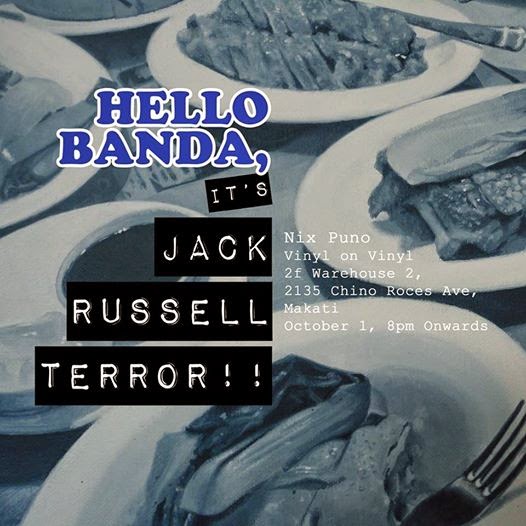
HELLO BANDA, It's Jack Russel Terror! by Nix Puno


October 1 to 23, 2014
Vinyl on Vinyl Gallery

Picture a nondescript place. It is dim but nowhere near quiet. People with eager faces fill the space and spill out onto the streets. Non-descript chatter and the sound of nonchalance fill the space. The room is brimming with wild anticipation. Then in one swift moment the hum of guitars cuts the murmurs into silence, and then transitions almost instantly into thundering excitement and blissful cheers. The air is electric with a sea of avid fans mouthing the songs that they’ve written. Three taps into the mic and the rest is history.

Hello Banda, It’s Jack Russell Terror!! celebrates the musicians that have carved their songs into the hearts of their audience, but in a way you least expect. Nix Puno goes past the spotlights, peels away the celebrity, and reveals the people behind the music, giving us a glimpse of life after the encore.

Nix Puno humanizes the glorified musician, giving us a glimpse of what happens when the mics are off and the guitars are unplugged. He gives color to the cheeks to the idols that have filled our ears with music that transcends time. He reveals a certain dimension to them and gives us a glimpse of the life that goes beyond the stage, and into the experiences that make their music what they are. In Hello Banda, It’s Jack Russell Terror!!, there is no stage, there are no idols. Just a group of people, grabbing a bite to eat, and having the time of theirs lives.

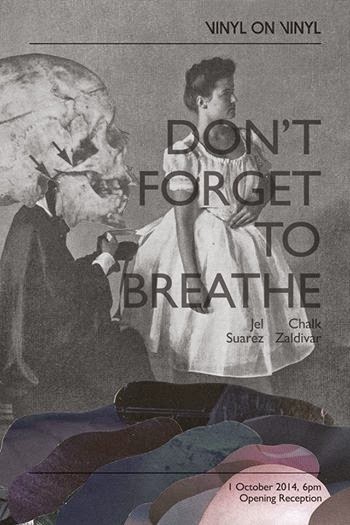
Don't Forget To Breathe - Jel Suarez & Chalk Zaldivar


October 1 to 23, 2014
Vinyl on Vinyl Gallery

In Akira Kurosawa’s Dreams, the master filmmaker reached inward to create a film that was built upon the dreams that he had over the years. The film was Kurosawa’s way of exploring different stages of his life, creating an artistic portrayal that favored visual splendor than dialogue. Dreams long been a major source of inspiration for different forms of art and in Don’t Forget to Breathe, artists Jel Suarez and Chalk Zaldivar recorded their dreams for a month and translated them through a series of collages that aim to show the humor, profound tragedy, and strangeness of their hidden fears and desires.

Suarez’s work aims to organize her thoughts through her collages in creating a visual narrative, while Zaldivar’s work ridicules the notion of his dreams. The medium that they use creates a stark separation between the two: Zaldivar utilizes odd shapes and colors cut from glossy modern magazines, while Suarez creates scenes from intricately cut objects and characters from old magazines and forgotten textbooks. Suarez revels in black and white subjects and imagery while Zaldivar shows zest with his colorful cut-outs.

Don’t Forget to Breathe is capped off with a dreamy, animated video installation that combines the two artists’ cut-outs to create a singular vision. The video is a colossal piece that shows the conflicts, the zigs, and the zags found inside the two minds that form this show.

Click the links below for photos of the artworks:


Friday, October 10, 2014

See You Later, Hello Banda It's Jack Russell Terror!, Don't Forget To Breathe

Thank you to everyone who dropped by last October 1 despite the pouring rain. You can still drop by the gallery (Tuesdays to Saturdays 12 nn to 7 pm) and view the exhibit until October 25. See you later! :)